
Take the money and crawl.
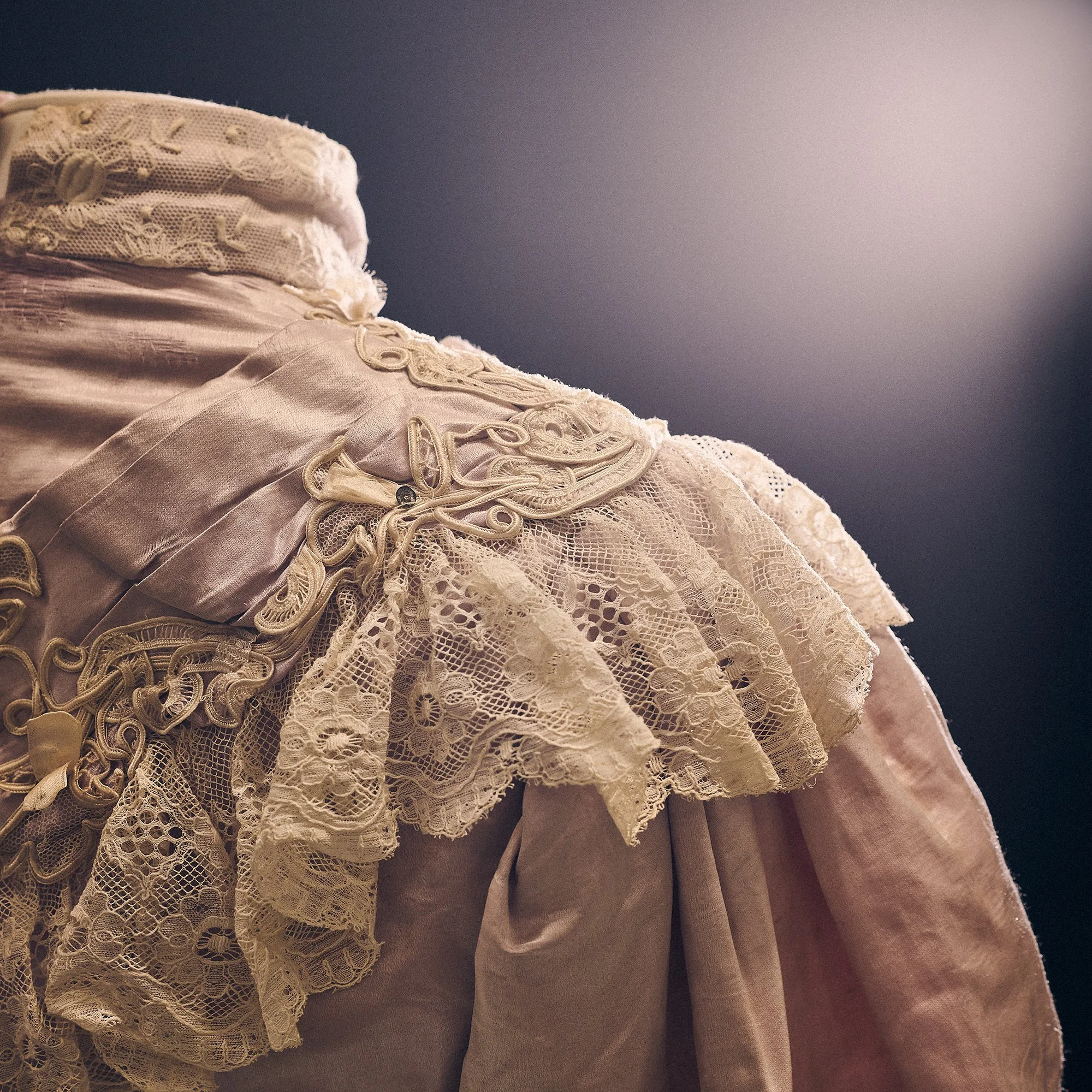
Una Donna di Due Isole, (detail) 2022. One of the few artworks I’ve sold - a photographic inkjet print on A1 Hahnemuhle 308, with an embroidered contour line with silk embroidery thread (not pictured). This is a photograph of Great Grandma Rosa’s wedding dress, from 1909, currently housed in Te Papa’s collection.
I’m having another minor existential crisis. Although that’s definitely overstating it somewhat, it nevertheless feels like an honest thing to admit. As this year grinds to a close, I’m reflecting on what has been, and more importantly, considering where I might pour my energy next. In terms of industrious activity over the past months, my cup truly runneth over. I’ve had a share of interesting photographic work to keep the wolf from the door, and even more hustle bustle with the artist residency role I fill, and with my sons extra curricular lives… rowing and karate and committees and volunteering. Life is full and from the crown to the toe, I actually wouldn’t wish it otherwise.
But I will confess a measure of specific dissatisfaction. The balance is off. I haven’t managed to carve out nearly enough time for art making this year. The bits that do occur are shoehorned into the little gaps between client work and family commitments. What’s more, they only happen because I’ve grabbed the chance to be part of something with an inbuilt creative endpoint and now I need to show up with the mahi. That’s good - I’ve extolled the virtues of an externally determined deadline in previous posts. I sometimes think that they are the only thing standing between me and complete inertia. I can at least say that I’ve been part of four exhibitions this year, and I’m proud of the new and expansive work I made for each of them. And yet… there’s an irritant in the oyster. The transition from the student life I enjoyed while progressing my masters, back into working as a photographer, and also into a fledgling art practice has been an uncomfortable one. Our everyday needs so frequently trump artmaking. What room is there for a lofty art practice when we need an ever increasing pile of coin for groceries and petrol and a new washing machine because the 7 year old one spat the dummy? Choosing an artist's life is widely acknowledged to be choosing a life of relative poverty. I don’t think it should be that way, but I understand that it’s part of the unwritten agreement. We expect to struggle for the noble reward of doing ‘what we love’.
Society at large values creative pursuits in theory, but less often in practice. Imagine if you will, living in a world devoid of art, music, dance, and literature, - a life without cinema and live performance, or poetry. Aside from the danger inherent in a sizeable wedge of our population - (those who dedicate their lives to the arts) - with nowhere useful to direct their creative energy, the remainder of society would exist in a world of grey, stagnant utility. The creative sector is what gives colour to our world. I liken the arts to the flowers in a well tended garden. Their general function may seem to be providing beauty, rather than sustenance. We know that bees need the flowers to pollinate fruits and vegetables - that pollination is an essential part of our existence, allowing reproduction of (according to google) a third of the food we rely on to survive. I could stretch this metaphor so much further, to account for the actual good that the arts do for humanity. You’ve probably seen that figure, published in the last year, of the 16.7 billion dollars that the arts sector contributed to the New Zealand economy in 2024. That’s a lot of singing and painting and Brokenwood Mysteries doing financial heavy-lifting. Just like a bountiful strawberry harvest each summer needs both bees and flowers, we need the arts to keep us healthy and progressing as a society. To advocate for the vulnerable, innovate without restriction, and to satisfy our quest for knowledge and pleasure.
I was having a conversation a while ago with a friend - Harry Culy, about having a day job to support a fledgling art career. I’ve made the assumption that I can continue to run a commercial photography business to help fund my art practice. Harry works as a technician in the photography department at Massey University, solving problems and teaching students. His day-job and mine both seem to be ‘art-photographer adjacent’. I’m probably on the tools, so to speak, with my camera more often, but he’d be hanging out a darkroom much more frequently than me. Harry is a respected photographer, and his work is found in both public and dealer spaces. He sometimes accepts jobs that place his photography in a commercial context, but always at his discretion, and he is chosen because of who he is as an artist. I’m often hired because people want what I can do for them, based on what they see me do regularly for others. But they’re not usually hiring me on account of my artmaking.
I think that there’s an unspoken reality that commercial photography complicates a photographic art practice more than nearly any other main gig. Somehow, the art world perception of commercial activity is that it cheapens the art that is also made by the same practitioner. Many people would argue with me on this point - that 1. there are lots of commercial photographers shooting ‘personal work’, both short and long form projects that aren’t instigated by a client, and they’re selling prints and photobooks of their work privately. And that 2. there are many fine art photographers who also shoot for clients, producing fashion and editorial images, and sometimes work on brand campaigns. Perhaps my insinuation that there’s an inherent snobbery about artmaking is based on a falsehood. I’ll stand by it though. I’m learning that while I can pour all of my intellect and passion and skill into my photographic art practice, while I’m simultaneously shooting advertising and editorial features, I’ll never be taken seriously by a dealer or a public art gallery. I think in some places, there might be a microscopic minority of photographers who combine the two things more convincingly - I can think of only a handful worldwide who do both things well. Nadav Kander sits in both worlds, but I would suggest that the artmaking vein of his work is by far the dominant one. Eugenio Recuenco might be another - his mastery of the medium lends itself to his particular kind of tableau picture making, and works for advertising as well as for gallery spaces. Both of these photographers engage with multiple kinds of public, but I’m pretty sure both primarily want to make art and would happily abandon advertising if they could live comfortably while doing so.
Another two artist friends I’ve talked with in the past have quite opposing ideas about how to support their art practice financially. Both of them have earned enormous respect, both from me and from the public and private art intelligentsia. One of them has a regular avenue of income from the multiples they produce - smaller items that can be sold retail, - still an integral part of their practice, but affordable for ordinary individuals to invest in. I have several pieces by this artist and I absolutely treasure them. The other artist produces work for public art spaces and private collectors, but you’ll never see her work in a shop. She has said that that mode of consumption undermines her practice, and she won’t offer pieces of herself that way. I have one of her works on my wall, gifted to me by her, and I treasure that too.
Historically, great works of art and music were commissioned by a patron- the upwardly mobile aristocracy. Most of the art in Western history happened because a king or the church paid for it, and they had a fair bit of say in what was produced. I think today Mozart and Michelangelo’s work wouldn’t be made because of a lack of actual patronage. I also think the Sistine Chapel frescoes only happened because Michelangelo didn’t have a nine to five that robbed him of energy and opportunity. Oh, some kind of music and painting would exist, regardless of public patronage. Those of us driven to create do so whether there is a financial reward or not. But the perception of value from creative pursuits tends to change with the economy and the political landscape. We know that Tory Whanau commissioned a painted portrait for her mayoral legacy - and whether you approve of that or not, Clark Roworth painted that with his particular expertise with the brush, and the Wellington ratepayers funded it. I’m personally stoked that a local artist got that commission, and she chose somebody with an undeniable talent for revealing character in his paintings. The sad reality of contemporary public funding is that those opportunities are rare as hens teeth. With our government cancelling the Interislander ferries a few years ago, a large group of artists lost major commissions. Nobody really thought about that when the deal was broken. Except the artists, who suddenly needed another way to provide for their families. They’d already invested significant time and creative resource into the project, and a change of political direction incinerated it all.
Today, an artist of sufficient reputation might be engaged by a brand seeking credibility. Collaborations between artists and brands are an uncomfortable marriage, made better when values align and the vision is afforded to the artist. When this happens, the brand receives the cachet of working with a prestigious name. Louis Vuitton brought in Yayoi Kusama to produce collections and the fashion public ate it up. The company experienced such favourable response, including elevated sales, and so engaged Kusama again a decade later. Examples of art photographers collaborating with brands for advertising purposes are abundant, but not many of them have much longevity. One-off projects have the dual purpose of recognition for the brand, and compensation for the artist, but rarely could you say that the collaboration benefitted the artist’s practice in any way other than financial. I admit I am oversimplifying something that is generally complex and nuanced, but I’d love to hear about photographers who sustain a practice that lives comfortably in those two opposing worlds. I’d really love to.
I don’t know a lot about music, but my husband told me a story about Greenday recently that illustrates this tension so perfectly, and it’s as much about perception as about integrity. In the 80s and 90s, indie credibility for musicians meant that if you were recording with a small record company, you were operating according to the rules. Signing to a major label meant you’d sold out, and you’d be shunned by everyone who matters, all credibility in tatters. Greenday were a San Francisco punk band, and their early records were with a minor label called Kerplunk. Like so many contemporary musicians they aspired to play at an indie club called 924 Gilman Street, and it was there that they got their break. In 1993 their popularity skyrocketed and they signed with a major record company - Reprise / Warner Bros. Gilman Street’s policy reserved their venue for independent bands - those making authentic punk music. When Greenday signed with the major label they were banned from the club altogether. The community they’d grown up in turned hostile, and all credibility was lost. Fourteen years later they were allowed back to play a benefit concert. The band were demonstrating that even though they’d been ostracised by the scene they grew up in, they still cared about that scene. You see, the unwritten rule of indie music is that you have to maintain a struggle to be properly authentic. If you make something commercial, then that undermines all of the other things you might put into the world, regardless of how hard you worked, or how well they are received.
These rules of conduct seem so arbitrary, but I think it’s an inherently human way of keeping us in the boxes we’re expected to stay in. Artists might be taken seriously if they remain commercially irrelevant. Commercial photographers can play at artmaking, but shrugging off the shackles of the client relationship isn’t enough to convince a gallerist that the work has depth. The perception of integrity is a fragile thing, and above all, we are expected to stay in our lane.
What we need are more patrons.
Artists need time, space and materials to develop good work. Although we’ll go on making things anyway, the best development happens when we can shake a thing around for a while, sift out the muck and discover the gold that’s left behind. We need to do that without the terror that our cost of living crisis hanging over us. I think the danger in the current economic climate is that the artists we are left with are those who come from particular kinds of privilege. Those who can carry on developing an art practice even if nobody is really paying for it, because their survival doesn’t depend upon their paycheck. Those artists are for sure going to make wonderful and interesting things, but they don’t represent the people at large.
Well, there are some opinions for you. I don’t actually know what the next year will bring, but I’m scheming a change of focus, and you’ll see it happening over the next months. Like all things creative, it’s a risk to invite change, but I’m not scared of that particular wolf. And you know what my mother always said to me - a change is as good as a rest.